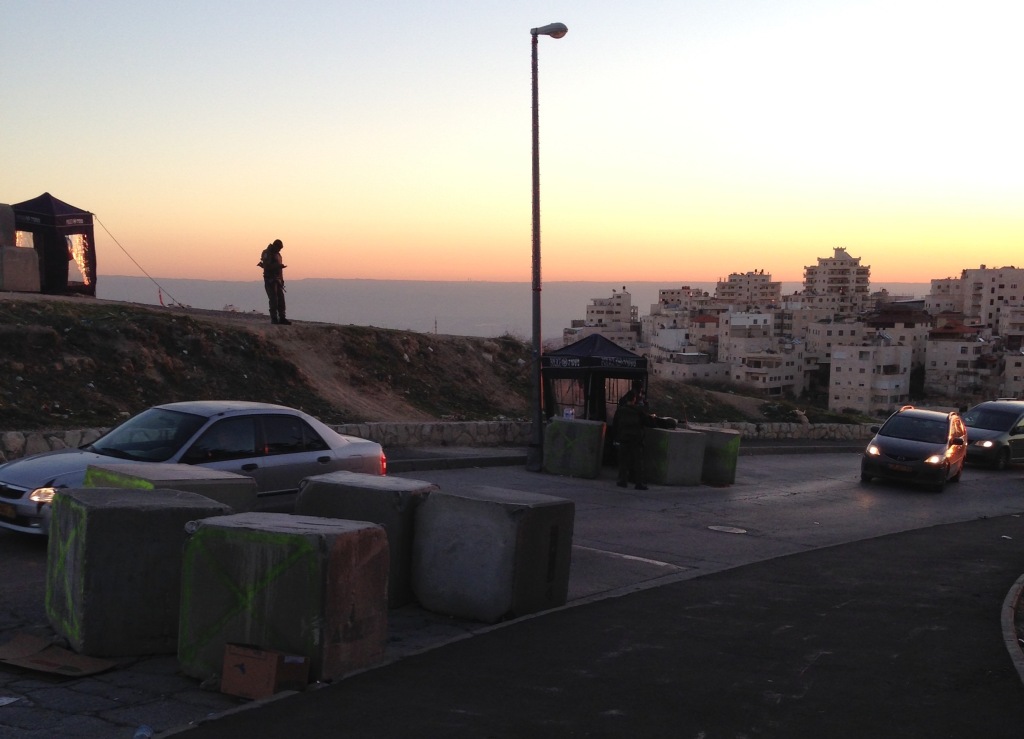
The Shamasneh Case: How the Nakba Continues in East Jerusalem

{This piece was originally published on the Times of Israel}

In Jerusalem, there is a family of ten people. They live in a small house on a quiet street, not far from the Jerusalem bustle of cars and tourists and hotels and diplomats, but removed, out of sight. The grandfather and grandmother have been living in the house for over four decades. Their son and their son’s children have known this house as home for their entire lives.  The house has a narrow staircase and a low door.

The Shamasneh family outside of their home in Sheikh Jarrah. 

On Monday, May 20th, the Supreme Court will meet in its lofty Jerusalem halls, with their swooping marble archways and breathtaking high ceilings, to discuss whether or not this family’s home should be taken from them and given to members of an American-funded organization. This is a legal case- nothing more, nothing less. Israeli law states that a person who can prove pre-1948 ownership of property may take their claim to court and “reappropriate” their house (or may have their claim taken to court for them by said American-funded organizations). This is a question of law, the backbone of democracy, and upholding the law.

The law, of course, does not apply when it comes to non-Jews, ie., Palestinians, hundreds of thousands of whom have documents proving ownership of homes within Israeli from before 1948 and are not allowed to set foot inside of Israel, let alone take property claims to the Israeli courts. The judges will speak of technicalities and details, of “absentee property” and “protected tenants” and “general custodians” and “balance.” They will not speak of “justice” or “equality” or “forced expulsion.” This, to our Israeli system, is a story of crime and punishment: the crime is being Palestinian in Jerusalem, the punishment is potential expulsion and constant fear. All is legal, all is well.

The specific family in this case is the Shamasneh family. This family is also the al-Kurd family, evicted from their home in Sheikh Jarrah in 2009 along with three other families. This family is also the Kneibi family, whose Sheikh Jarrah house has also recently come under threat of takeover by settlers and has their next discussion scheduled for October. This family is the dozens of other families in Sheikh Jarrah (many of whom are refugees from 1948) who live in fear of being expelled from their homes. This family is the thousands of families throughout East Jerusalem and the West Bank who face eviction and expulsion as part of a quiet (or not so quiet if you ask folks like Naftali Bennet) Israeli government plan to transfer Palestinians out of the majority of the West Bank and major neighborhoods in East Jerusalem, with the blessing of the courts and the JNF and the Nature and Parks Authority and Tel Aviv University. This family is one of the hundreds of thousands of Palestinian families currently suffering from a Nakba that never ended. The Nakba, Arabic for “disaster,” is the Palestinian word to describe the events of 1948 in which hundreds of thousands of Palestinians were forcibly expelled or fled their homes (and here, a quick counterfactual to blur the line always drawn between “expelled” and “fled”– what if Hamas took over Be’er Sheva homes last November when most of the city’s population had fled from fear of rockets: would that be “OK” because the people there had chosen to flee, or would we consider that a form of forced expulsion?)

The Nakba, which will be commemorated tomorrow, on May 15th, is characterized by the Israeli government’s intentional expulsion or transfer of parts of the Palestinian population. This was done in 1948 en masse and by the military, with widespread violence under the banner of desperation. It is done in 2013 in suits and with a great calm, house by house (and sometimes village by village), through jurisprudence and law and under the banner of Israeli democracy.

Tomorrow, as we in Israel remember (or try our best to to ignore) Nakba Day, let us also grapple with the thought that the Shamasneh family is facing a small scale Nakba of their own, that if the courts decide to rule in favor of the settlers, the Shamasneh family will be expelled from their own home and replaced by Jewish settlers whose goal seems to be to ensure that “Shimon HaTzadik” (as it is also called by the Jerusalem Municipality’s Light Rail) is a Jewish neighborhood, and that the name “Sheikh Jarrah” is added to the list of Palestinian villages and areas that once were, before some version of the Nakba reached them, and are no longer.

Posted in East Jerusalem, Housing Demolitions & Evictions | Tagged , , , | Leave a comment

All That’s Left: A Diaspora Collective Against the Occupation

Introducing:

All That’s Left:

A new collective committed to ending the occupation and building the diaspora angle of resistance.

524807_449179305157445_1011615918_n

This is worth following (and getting involved with).

First things first, our Facebook page was just launched, with a list of recommended books, articles, audio-visual and a blog roll. It will continue to be updated with videos, photos, invitations to action and, in general, All That’s Left. Word:

http://www.facebook.com/AllThatsLeftCollective


Posted in Stories of Days | Tagged , , , | Leave a comment

“Jerusalem II” by Moriel Rothman

“Jerusalem II.” Spoken word from Jerusalem’s worst day, yesterday, Jerusalem Day. The sea of flags made me sadder than I have been in a while: most of the marchers probably had no idea that for the few hours leading up to their procession, Israeli police were busy terrorizing, arresting, hitting and clearing out Palestinians so that the march could go through the Damascus Gate (in Occupied Palestine) without the marchers having to see a single counter-protestor, a single Palestinian flag, a single thing that might dampen their day. They seemed to be having a really nice time. Here’s to better days:

And the original, “Jerusalem,” (2012) for those who missed it:  

Jerusalem

Your sidewalks are so soft

They feel like jelly donuts

Continue reading

Posted in Poems | Tagged , , , , | Leave a comment

A Truck to Break the Occupation (Ezra Nawi Truck Campaign)

I. A Portrait from South Hebron

The hills are rolling and crumbling at the same time.

The wheat that whispers in the wind sticks sharply into my legs as I shuffle across the field to join the group of colorful shirts surrounded by dull green shirts and dull metal. The morning is crisp and calm. The ritual is the same. Palestinians farmers and their young children declare their intention to work land claimed by settlers, the army rushes down to prevent them, settlers look on from a far, the international and Israeli activists stand tweeting and twittering, video cameras in hand. Step one-two, step two-three, step three-four, step one-two. Today there are no clashes. Today the dance is tired and ritualistic. A white jeep bounces over the crest of the hill, and the air is lifted: Ezra. The Palestinian farmers laugh and say, “get the hajj Ezra some tea.” Everyone knows him by name. The soldiers mutter to each other, all of them know him by name also. Ezra gets out of the car, grinning and speaking Iraqi-Israeli Arabic that bounces smoothly like a white truck over rocky ground. Two of the small boys run over to him.

“We got a call,” Ezra says, telling whoever is listening –soldiers, activists and farmers– of a Palestinian farmer nearby who caught settlers poisoning his well– likely his main water source, as the villages in the South Hebron Hills are not connected to any grid, despite pre-dating the Occupation and Israel itself. This is part of the ritual, I remember, step one-two, step two-three, part of the game here is that in the process of dancing, Palestinians regularly have their property destroyed, the livelihood crushed, sometimes their lives taken, and they are not asked whether they want to dance.

A few of us pile in Ezra’s jeep, and are followed by a convoy of two jeeps. Ezra is off to visit the man whose well was poisoned. On his way he drops myself and another Israeli and an Italian off near where a lone man is herding. The man sees us, stops, raises his hand and calls, “Ah, Ezra!”

“Go with him,” Ezra tells and us, and the jeep is fading into the distance, green jeeps in tow, before we have fully stepped out.

url

II. Ezra

I met Ezra a few days after I first arrived in Jerusalem in the Fall of 2011. Members of the Rabbis for Human Rights legal team were heading out to the West Bank to research a case concerning a settlement’s expansion of its “special security area” onto more private Palestinian land. Ezra was then to me as he has been each of the many times I have seen him since: gruff, distracted, teasing but with eyes echoed a deep kindness. “You speak Arabic,” he says to me, in Arabic. “How does a nice religious boy like you know Arabic?” I laugh, adjust my kippah, and look out the window as we bump through the dust and rocks. Ezra Nawi, an openly gay retired plumber whose parents came to Israel from Iraq, is a man who has dedicated his life to others and to this place. Each week, he drives over 1,000 kilometers, shuttling activists, lawyers, journalists throughout the fraught and justice-draughted South Hebron Hills, visiting Palestinian farmers, villagers, families. Everyone knows him. From what I’ve seen, most Palestinians respect him deeply –with a high degree of mutual amusement–  and many settlers and soldiers loath him. He is rougher than the rest of the activists, he tells the soldiers directly that they are committing horrible acts, tells them to go home, tells the settlers that he thinks they are doing evil things. But he has a softer side, as well, and when the dance shifts from ritualistic to serious, when people living in these Palestinian villages are hurt or threatened, it is then that the compassion which is his motor and engine shine through.

url-1

III. Donate

Speaking of motor and engine, though, riding in his jeep often feels like a trip back to the late 1980s. This jeep is possibly the single most important material resource for those seeking to bring justice and break the cruelty of occupation in South Hebron through committed nonviolence, human compassion, direct action and access to information. And this jeep is quite literally crumbling. And so, I am turning this post, which I started writing as a reflection on my recent trip to South Hebron this past weekend, into an ask: Please help donate to buy Ezra a new truck. This is incredibly important. I don’t often make fundraising pitches (the last one I did was also connected to Ta’ayush, the South Hebron Hills, and the stark injustices that take place regularly there).

I am truly convinced that there are few better ways to funnel money against occupation and injustice than to help Ezra –to help all of us– get a new truck. Here is the link to the campaign: http://www.indiegogo.com/projects/ezra-nawi-truck-campaign

Thank you in advance.

url-2

Posted in Israel's Military Occupation of Palestine, Susiya | Leave a comment

“I Refused to Join the IDF” (An Interview with Vice Magazine)

[This piece was originally published in Vice Magazine]

I Refused to Join the Israeli Defense Forces

By Alon Aviram

Young members of the Israeli Defense Force. (Image via.)

Moriel Rothman doesn’t sound bitter when he reflects on the contradictions that formed his childhood identity and eventual political outlook. In fact, he sounds more saddened, if anything. “On the one hand, my heroes were Israeli commandos, and on the other they were the young Jewish American Freedom Riders [Jewish civil rights activists in 1960s America]. I held these two together without fully coming to terms with the fact that there might be a contradiction.”

That contradiction, if you hadn’t picked up on it, stems from the fact that while the Freedom Riders were fighting for the rights of America’s persecuted minorities, Israeli commandos were systematically crushing the rights of their persecuted Palestinian neighbors.

Moriel is a 23-year-old American-Israeli who was born in Jerusalem, spent most of his life in the US, and is now back in the city of his birth. “I think we’re brought up to talk on a universal level about values of justice, standing up to inequality, breaking the law when the law is unjust, and standing up for the oppressed,” he continued. “But not when it comes to our own context—not when it comes to Israel and not when it comes to standing up for Palestine.”

Late last year, Moriel spent time in a military prison for refusing to live out the first part of his childhood dream: the military commando. Military service in Israel is mandatory by law for Jewish youth and young people from the Druze religious minority, however, only around half of those eligible enlist and many more leave during their service.


Moriel Rothman.

New Profile, a self-declared movement for the demilitarization of Israeli society, cites many reasons for why people may choose not to serve in the Israeli Defense Forces (IDF), including “economic, political, ideological, religious, and medical reasons, as well as a refusal to join an oppressive, chauvinistic, and violent program”.

Nonetheless, the military holds a unique position in Israeli society—one invested with an almost sacrosanct air of authority. Military rank instils pride among peers and grants social status; a sure incentive for many in Israel, particularly those who find themselves stuck on the lower rung of what is an increasingly unequal society. Military service is an accepted, often eagerly-awaited rite of passage. It shapes your character, language, friendships, and perception of the world, all under the grand narrative of national responsibility.

“It’s glorified, almost worshipped, which is frightening for me as someone who cares so deeply about the Jewish people and about the Jewish religion and this place,” Moriel continued. “The idea of a society becomes more and more centered around the army as an almost essential and sacred value is a frightening idea.”

Continue reading

Posted in IDF & Refusal to Serve | 3 Comments

Trinlingual Spoken Word @ Yesh Gvul’s Alternative Ceremony, 2013


Here is a poem I performed at Yesh Gvul’s Alternative Ceremony, April 15th, 2013

בחור אחד בכלא שאל אותי

אז מה, אתה שמאלני

What are you, a Leftist?

فانا قلت اله: اه

Uh huh

אכן, I am

A Leftist

שמאמין שבצלם אלוהים נברא אדם

ושרוב הדם שנשפך לאחרונה נשפך סתם

عن طريق الاحتلال من سوسيا لسلوان

So I refused to pick up a gun

Propelled both by my ego and a sense of justice

And I just hope that you can trust this proclamation

שזה נעשה מתוך אהבה

מתוך אמנוה

לא מתוך שנאה

אני לא שונא חיילים, רק נגד הצבא

שכובש ודורש שנראה את שכנינו כפחות שווים:

انا اسمي مش مهم وانا عمري ١٣

وكنت قبل شهر مسجون في مچراش هاروسيم

הרוסים הבתים הרוסים מבפנים

We are singing the silent siren song of self-deception

שרים על הגוי שלא ישא חרב

ובנשימה השניה שרים שיר מלחמה

But you don’t really want to go to war, do you

Jerusalem?

I don’t really want to go to war either,

Jerusalem.

We don’t really want to go to war anymore,

Jerusalem.

אז אני שר למען נתן

וגם למען סוהייב

Thanks to Sahar and Amani

And what I learned from Gaza and Abu Ghraib:

انه العنف بيجيب العنف

Violence begets violence

אלימות מבאיה אלימות

فخلص، بكفي، מספיק

Speak: it’s enough.

בחור אחד בכלא שאל אותי

אז מה, אתה שמאלני

הוא שאל אותי

What are you, a Leftist?

فانا قلت اله: اه

Uh huh

אכן, I am

A Leftist

אז הוא אמר לי:

אחי, אתה חייב ללמוד:

يا زلمة، لازم تتعلم:

Man, you’ve gotta learn:

Aikido.

Screen Shot 2013-04-19 at 5.55.11 PM

Posted in Poems | Tagged , , , , , , , | Leave a comment

Flags Revisited

1. All of them flup flupping

God today is also a windy, a delicious day


2. If I die in a suicide bombing

please do not remember me

as a Suicide Bombed.


3. Again outside of the hall again, six or twelve or sixteen people

yell PalestiNazis! PalestiNazis!

their voices cracking into a megaphone.

My friend had forgotten that her folks’ car

was beflagged but no one throws stones

in North Tel Aviv.


4. flup flup


5. The kid with the slingshot had a grass-night-cloud and berry

mask wrapped around his face. He looked

scary. The kids down the street have cloud and topaz

draped over their shoulders. They look–

Let’s don’t compare, shall we.

The profit intones:

Let nation lift up flag against nation

Let them wave their cloths somemore.


5. Four planes fly over, leaving cloud trails

in the topaz sky [Note: A Metaphor], huddling together in for[warmth]mation

and then down towards the buildings

I look at my phone, 4-16. Not as crisp

as 9-11. The planes swoop back up.

Someone cheers.


6. Did no One get the memo that fireworks

works poorly in a society that hasn’t yet reached the Post

part of -TSD. Or maybe that is

the point.


7. I still don’t I don’t I

do not.


8. As the second siren goes

off an [presumably] Arab worker

continues banging on a wall.


9. flup flup flup

Posted in Poems | 1 Comment