
Because you cannot make peace with an M16. Although maybe you can make prosperity.
Author: Moriel Rothman-Zecher
American-Israeli writer, poet and novelist.
How to [Unsuccessfully] Request a Conscience Committee to Get Out of Serving in the IDF
“What are you here for?” The soldier at the gate asks me. “I’m here to…” I breathe: Honesty. No games. Honesty. “I’m here to request a Conscience Committee [Hebrew: va’adat matzpoon].” “A what?” “A Conscience […]
Draft Orders to Join the IDF; Refusal
Dear friends, On October 21st, 2012, I am expected to become a soldier in the IDF. I was born in Israel, am Jewish, am male and am under 26 years old and thus received a […]
Notes on the State Sanctioned Theft in Ras al Amud
This past Sunday, part of the Hamdallah family’s house in the Ras al-Amud neighborhood of Silwan, in East Jerusalem, was taken over by settlers, in coordination with a court order. The law here is illegal. […]
Book Review/Recommendation/Rave: “Infinite Jest,” by David Foster Wallace.
And so yes, I, Moriel Zachariah Rothman, aged 22 years, spawn of smalltown Ohio and educated deep within the pretenses of New England Higher, am grimacingly-and-yet-whole-heartedly adding my name to the long list of young writerlets who “discover” David Foster Wallace’s work- although I differ from many of my peers in my inadvertent aversion of the intellectual, and in some cases personal, trauma, in that I am “discovering” his work posthumously (ie., his)- the long list of young writerlets who “discover” David Foster Wallace’s work and have part of their pen-grasping left brain sort of like scooted over. It takes a lot to scoot a brain. And who have part of their soul truly cracked open, and are thereupon simultaneously overwhelmed by a renewed desperate sort of desperation to write and a sort of paralysis in that all penmanships/keyboardwomanships seem to pale in the shadow of such a Giant of Staggeringly-Clever-and-also-Simply-Heartshattering Writing. After all after all after all.
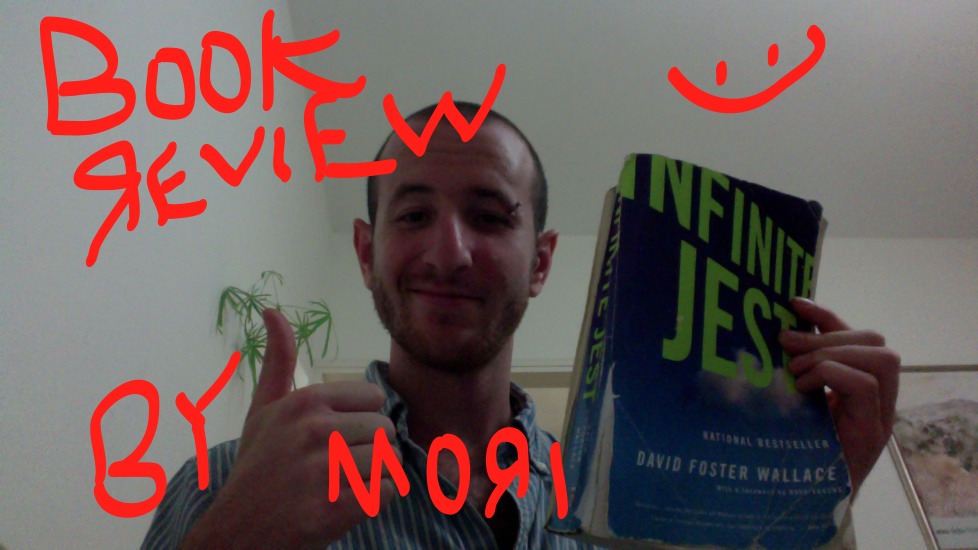
So. Instead of just writing about my reading experience, my own Writer’s Voice too confused and heavy with attempted-emulation to be bearable, let alone anything else, I think that I will simply quote a few the lines and passages from David Foster Wallace’s Infinite Jest- one of the most Biblical (not to blaspheme) secular books I’ve ever read, in its complexity, self-referentiality and weight (physical as well as emotional). I think I will simply quote a few of the many lines and passages from Inifinite Jest that most struck me through either their acerbic-social-critique and unabashed-lingual-joy-and-cleverness or their almost-unbearable-tragedy-made-bearable-through-profound-and-maybe-even-life-altering-other-directedness (this phrase, other-directedness, is borrowed from DFW himself, and although he generally uses it semi-sarcastically (in his “This is Water” speech at Kenyon; on page 138 of Brief Interviews with Hideous Men). I think it is really what Infinite Jest is aiming at, and it is why I draw so much inspiration from his work, this idea of crawling just far enough out of the ravines of our own self-directed internal universe that we can truly act and live in a way that is other-directed, and when we fall back into the caves, we can be lifted back out again, perhaps through reading and rereading that which reminds us to be other-directed, DFW’s work being, of course, only a few of so many examples of such.
All of that said, I do want to insert three caveats into this over-ambulatory preamble. (1) If you read the first 200 pages of the book only, you might not like it. You have to commit to reading at least the first half of the 1,100 pages (reading this book took me longer than any novel I’ve ever read). Otherwise don’t read it. (2) There is something that feels not-completely-safe about this book. The best analog I was able to come up with is hallucinogenic mushrooms. You can have an incredible, POV-altering experience through it, and it also might even help you become a better person, as Dave Eggers (another author I am a big fan of) says in his intro to IJ, but it can also send you into very dark, mazelike places if you let it take control. I found that at various internvals I needed to put the book down and balance it with something ultralight (so pronouncedly NOT television), jogging or having a snack or piercing my eyebrow or something. So read it, but read if you take it seriously, also take seriously the darkness and confusion and weight of the dark, confusing and weighty parts of the book. (3). It is important for me not to emphasize that I do not intend to Deify David Foster Wallace. Like really important. He was a brilliant brilliant writer. Probably one of the best I’ve ever read. But he was also a deeply troubled and sick person who killed himself. My brother, Jesse, had me read an essay by DFW’s friend and colleague Johnathan Franzen, which I found both moving and sobering:
“He [DFW] was sick, yes, and in a sense the story of my friendship with him is simply that I loved a person who was mentally ill. The depressed person then killed himself, in a way calculated to inflict maximum pain on those he loved most, and we who loved him were left feeling angry and betrayed. Betrayed not merely by the failure of our investment of love but by the way in which his suicide took the person away from us and made him into a very public legend. People who had never read his fiction, or had never even heard of him, read his Kenyon College commencement address in the Wall Street Journal and mourned the loss of a great and gentle soul. A literary establishment that had never so much as short-listed one of his books for a national prize now united to declare him a lost national treasure. Of course, he was a national treasure, and, being a writer, he didn’t “belong” to his readers any less than to me. But if you happened to know that his actual character was more complex and dubious than he was getting credit for, and if you also knew that he was more lovable–funnier, sillier, needier, more poignantly at war with his demons, more lost, more childishly transparent in his lies and inconsistencies–than the benignant and morally clairvoyant artist/saint that had been made of him, it was still hard not to feel wounded by the part of him that had chosen the adulation of strangers over the love of the people closest to him.”
[From Franzen’s ”’Robinson Crusoe,’ David Foster Wallace and the island of solitude.”]
Ok. Caveats listed. Back to raving. So. First. Other-Directedness. He says it all succinctly -and directly- in his aforementioned “This is Water” speech, probably his most widely read piece in my college-circles, as it is a helluva lot more digestible and bite-sized than Infinite Jest’s 378-footnote 1,100 page extended version of what I think is more or less the same ideas- but I hope to make the case (for I have to make some case, do I not, on this blog usually devoted to political posturings and strident denunciations and nunciations, et cetera) that if you are moved by “This is Water,” or even by the quotes which I still haven’t gotten to adding, that you must read Infinite Jest. There he writes like this:
“That sometimes human beings have to just sit in one place and, like, hurt. That you will become way less concerned with other people think of you when you realize how seldom they do. That there is such a thing as raw, unalloyed, agendaless kindness… That everybody is identical in their secret unspoken belief that way deep down they are different from everyone else. That this isn’t necessarily perverse. That there might not be angels, but there are people who might as well be angels.” (pp. 203-205).
Chaotics
sometimes there are seven or ten thoughts that run through one’s head like darts like justice like long long reeds like cigarettes like the minor key like freedom like boredom (like hope like time like […]
Openness, Darkness and The Tearing Down, Off and Apart of Assumptions
I am about to break one of my own rules: I usually don’t write about things I experience, think, hear or witness on Saturdays/Shabbatot. Taking one day a week to truly rest, to try to […]
How 2-3 Years in the Army Can Buy You 7 Extra Seconds Before You Are Called a Terrorist
At a demonstration, Friday afternoon (surprise). We are passing out fliers, accompanied by the drums of Yassamba (see above). The fliers decry our government’s latest plans of gut-wrenching injustice towards Palestinians (ibid). The crowd in […]
Walking the Leftern Wall to Listen: A Blogalogue
This is: a meeting of minds, of dear friends, of aspiring writers, realized wonderers, and marmots. Well, not marmots, but they are welcome should they happen to stumble down into the Lone Star Café from the looming Sierras above looking for some friendship and Powerade here in Lone Pine, California. We, Andrew Forsthoefel and Moriel Rothman, have pursued radically different paths since graduating together a year ago from Middlebury College; Andrew has spent the year walking across the United States to listen and learn, Moriel has relocated to Jerusalem to struggle for justice via direct action and activism. We’ve been blogging our years, reflections, journeys and ruminations at Walking to Listen and The Leftern Wall, respectively. Thanks to Moriel’s heroic sojourn [MR: Not that heroic: I flew into Fresno and rented a car through Enterprise…] we are here now, together, for the first time in over a year. We thought it’d be cool to reflect, in a blogalogue of sorts, on the lessons we’ve learned and questions we have.
[The following conversation was the product of nearly six hours of passing the computer back and forth with no plan, no prompt, and no verbal communication. Enjoy!]
Part I:
Moriel Rothman: Hey man.
Andrew Forsthoefel: Yo bro. Are you distracted by Dr. Oz playing on the TV hanging above us?
MR: Didn’t know it was Dr. Oz. Now that you mention it, the TV-voices are gnawing little holes into my sanity. It’s taken me like four minutes to write this sentence. Can we move tables?
AF: Please. [Move to a dark, Dr. Oz-less corner of the café]. I can’t believe it took us that long. Yeesh. So, I’ll say first that it’s a complete refresher to have you here. One thing I’ve missed most during these past ten months on the road has been the presence of old friends, people who know me in and out, through and through, and who, equipped with that knowing, push me into different thoughts, feelings, epiphanies, places where solitude simply cannot go. And that’s what this little conversation is all about, right? Going where no Andrew-Moriel has gone before? I’m feeling two paths right now. Number one: Solitude. Number two: Dr. Oz. Choose your own adventure.
MR: Number two. For sure. I choose the Doctor. Ha. Honestly, I don’t really know who Dr. Oz is, although I gleaned from our little listen-in that his show has a sticky, hyperpopular, hyperlonely quality to it, not unlike the show hosted by a man whose chanted name haunted many of my American Days (“Maury! Maury!” “Well, actually it’s ‘Mori,’ as in ‘Moriel,’ as in ‘God is my Teacher’ in Hebrew…” Blink. Blink. “Maury! Maury!”). On this note, I am feeling pretty alienated from American culture and America these days. Your journey, though, and your writing has kept me connected to the parts of America that I love, and has shown me breathtaking, distinctly non-Ozian parts of America I had never come close to encountering in all of my 12 years in the Midwest and four in New England.
How do you say “Jim Crow” in Hebrew?
Sometimes, truth can be clarified through metaphor. In 1963, four young black man were assaulted by a mob of white men in St. Augustine, Florida. They were brutally beaten, and sent to the hospital with […]
 The Leftern Wall