
Dear readers, I’m taking some time off, and as such will be blogging at a much less furious pace. Meanwhile, feel liberated to peruse the archives, browse what I’ve been blabbering about for the last […]
Author: Moriel Rothman-Zecher
American-Israeli writer, poet and novelist.
J14 #2: Israel Social Protest Reaches New, Tragic Level of Intensity
Tonight, in the framework of Israel’s social protests– protests which were launched last year on July 14th (#J14) and have continued, smaller but in some ways more intensely, through this summer– in this context, a […]
Al-Ma’asara: The Cutest Demonstration Against The Occupation
Al-Ma’asara, a little village near the Gush Etzion settlement bloc, has begun to develop a reputation for its silly, creative demonstrations against the occupation, from dancing like birds to speaking to the soldiers in joyful […]
Pragmatism or Dogmatism: Hamas and the Dynamics of Ceasefire (An Academic Essay from 2010)
{Foreword: As contrasted to most of my blogs, which are short form, informally written, and not fact-heavy, this piece is an 8,000 word research paper I wrote during my final year at Middlebury College, in 2010, for a seminar on Political Islam. The basic argument, as stated in the conclusion is “that Hamas’ Islamic roots, while offering important frameworks for mobilization, do not determine its policy. Just as votes for Hamas must be largely understood as protest votes, Hamas’ actions must be largely understood as political actions. While Hamas’ rhetoric has been and continues to be radical and violent, its actions, as analyzed through the lens of its participation in ceasefires and lulls, have not lined up with its most radical declarations, and it can thus be concluded that Hamas would find a way to Islamically justify virtually any political position it desired to take. Hamas’ guiding framework can thus be described as pragmatism portrayed as dogmatism.” I decided to post this paper for a few reasons: 1. Because it is still a relevant- and I think under-understood- way of viewing Hamas and forming policies and opinions. 2. Because I now have a readership I did not have when I first wrote this paper and I want to share my work. 3. As proof that at least some of my opinions are based in study and research. :) So, this piece is probably 20 times longer than my usual pieces, so if you want to read it, maybe print, or save in a different window. If you try to read it as you’d read a blog, you will likely despair wicked quick}
Pragmatism or Dogmatism:
Hamas and the Dynamics of Ceasefire
What has led Hamas to abide by ceasefire with Israel in certain circumstances, and what can this teach us about Hamas, and about the ‘how’ of future engagement with the Islamic Resistance Movement?
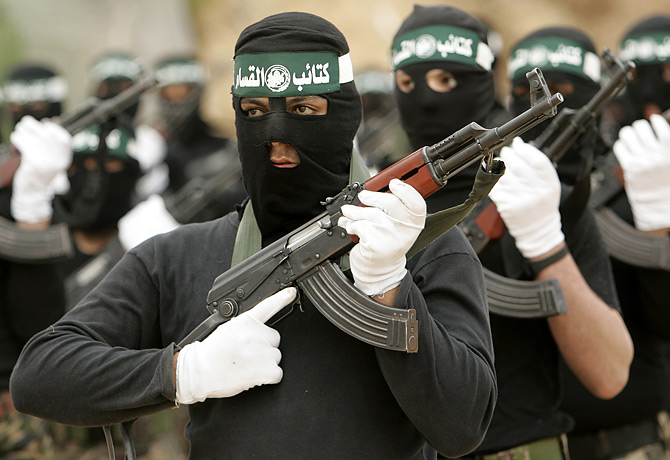
By Moriel Rothman
Political Islam
Professor Quinn Mecham
Middlebury College
December 2010
Introduction: Is Hamas Primarily Dogmatic or Pragmatic?
“Hamas is an idea,” according to Israeli author Amos Oz, an idea that “grew out of the desolation and frustration of many Palestinians.”[i] Oz, in his June 2010 article criticizing the Israeli government’s response to the Turkish Flotilla seeking to break Israel’s siege of the Hamas-ruled Gaza Strip, went on to write that because Hamas is an idea, the notion that it could be forcibly defeated is misguided. Thus, the only way for Israel to deal with the threat Hamas poses is by negotiating with Hamas, either directly or, “more realistically,” following its integration into Fatah [with whom Oz recommends Israel negotiate a peace deal post haste]. Oz’s analysis of Hamas corresponds with a theory by two scholars of Islamism, Dale Eickelman and James Piscatori, which argues that Islamism, or political Islam, is in essence protest.[ii] It is an effective channel for the expression of grievances- or perceived grievances. A fundamental assumption of Eickelman and Piscatori’s argument, and of Oz’s, is that Islamist groups with nationalist goals -like Hamas- are ultimately rational actors, and that they are motivated more by politics than by faith, more by reason than by dogma. Oz’s analysis paints Hamas not as a conduit for Palestinian Islamic fervor, but rather as a result of Palestinian political and social frustration. It is important to note that the designation “rational” in this context is not a value judgment: a political strategy based in massacre could be as rational as one based in dialogue and cooperation.[iii] In other words, the fact that Hamas’ tactics are despicable should not cloud an analysis of the extent to which the organization is pragmatic and flexible.
Oz’s argument, however, is by no means representative of the mainstream Israeli analysis of what Hamas is and how to deal with Hamas, and his article was attacked by another high-profile Israel writer, Ben Dror Yemini. Yemini, writing for the Israeli newspaper Ma’ariv, challenged Oz’s basic premise that Hamas’ existence had any connection to Israeli action. “There is no greater lie than the assertion that Hamas was established because of Israel,” Yemini writes, “Hamas arose as part of a worldwide awakening of political Islam.”[iv] The implications of Yemini’s conclusion are clear, especially when juxtaposed with Oz’s argument: Hamas, as part of the “worldwide awakening” is fundamentally irrational, and its supporters are driven by religious dogma unconnected to Israeli action.
Items in a conflict zone
I. Children in a conflict zone Oh! The little forgotten ones Curled up in fleshy balls on the hill- Side breezes lift them pill- Bug small they float Ah! It is so […]
How to Get Detained by the IDF without Being Aggressive, Provocative or even Loud

This morning, I ventured out to the village of al-Mufaqara in the South Hebron Hills. I went with four members of Ta’ayush, an Israeli organization that challenges the Occupation by helping Palestinian farmers access and work their land (they usually go out on Saturdays, so I don’t go with them, but am a big fan of their work and was excited to have this opportunity to go on a non-Shabbat). Our intent was to help the folks in al-Mufaqara fix a dirt road for a few hours, and then to go meet up with a tour in Susiya, right near by, led by the Solidarity Movement. We did both, but were “delayed” for a bit, between steps one and two… (Explanation forthcoming. Below is a picture of a few of the 20 soldiers who came. Backup!!! That is to say: Boredom).

Also with us in al-Mufaqara were a few lovely and friendly Italian volunteers from Operation Dove, a group that does peace and nonviolence work in various locales throughout the world, and in Palestine is based in al-Twane. These activists in particular, and their group in general, struck/strike me as the exact opposite of the sort of international activists I wrote critically of last week, humble, loving, nonviolent, dedicated (one of the volunteers, who told me she plans to stay for two and a half years, inshallah, spoke excellent Arabic). Together with these two, and a maybe twenty young boys from the village, ages 5 through 20something, and a few older men from the village, we began shoveling dirt into buckets and loading the buckets onto a truck. My little writer’s hands started cracking immediately, and I could only laugh at the fact that the seven year-old Palestinians were shoveling much more efficiently than I was. We were there, of course, primarily in solidarity and as a sort of “protection” (if Israelis and internationals are present, chances of violence from settlers or the army are decreased).

Work goes great, as far as work goes, and then, as we are heading to a different part of the village, the kids see soliders, and start chanting:
1, 2, 3, 4
Ockibush No More!
Huh? Laughing, I clap along. And then I get it:
1, 2, 3, 4, Occupation No More had blended, in their minds, with 1, 2, 3, 4 HaKibush (Hebrew for Occupation) No More.
Brilliant. Tamar, another one of the activists there, made a supersharp lingual observation that may translate only mediocre to English: The two words have the same root in Arabic.
Instructions: Three Simple Ways to Stand with Susiya via Facebook
1. Copy the following image and make it your facebook “Cover.” [Also, bloggers and other website owners should consider doing the same]. 2. Post this “Picbadge” […]
Ein Prat: “Forging a New Paradigm for Israel” (at the expense of Bedouin children)
At Ein Prat, which has both pre- and post-Army programs, young Jews from all different backgrounds, American and Israeli, secular and observant, liberal and conservative, come together to study canonical texts, both Jewish and Western. Nestled among rolling hills, these youngsters gather to “forge a new paradigm for Israel,” and in their spare time, some of them take part in a fun and funky Jewish music group called The Fountainheads.
Where does such a place exist? For some odd reason, Ein Prat’s location is not listed anywhere on its English-language website.
Here’s why:
Ein Prat’s programs, which attract many liberal-leaning American Jews, are located in Kfar Adumim and Alon. Kfar Adumim is a settlement, as is its satellite settlement Alon. Anyone who chooses to study at Ein Prat chooses to directly benefit from and support the continued military occupation of over two million Palestinians.
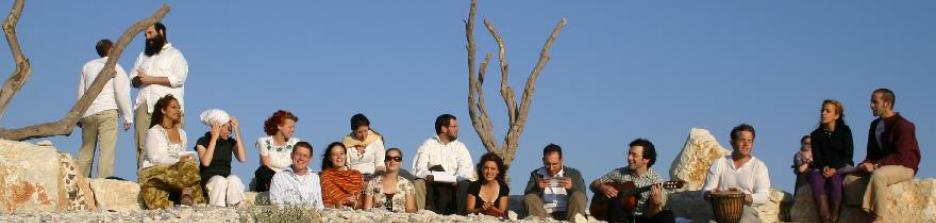
Picture from Ein Prat’s website.
To be clear: the people of Ein Prat, its faculty and students, could very well be -and indeed probably are- thoughtful, complex and kind people. I assume the same about most settlers, and most people. My criticism is not leveled at the character of the individuals of Ein Prat (many of whom I know personally), but rather at the system which Ein Prat necessitates just as much as do more explicitly ideological settlements like Yitzhar (home to Torat HaMelekh and active groups of “hilltop youth”). Indeed, without checkpoints, roadblocks and the denial of an entire people the right to vote for the regime that controls both their day-to-day life and their destiny, neither Ein Prat or Yitzhar could be where they are.
Of course, the students of Ein Prat would never go and beat up Palestinian children. In fact, Ein Prat probably encourages dialogue with Palestinians. And yet, the violence enacted by both places is, at its root, disturbingly similar: a systematic, structural violence.
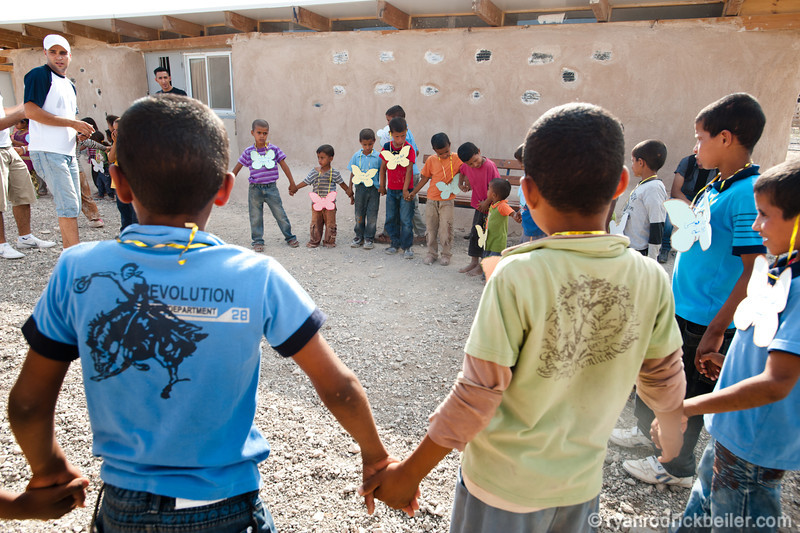
Picture of Khan Al-Ahmar’s elementary school, which Ein Prat’s Host Settlement Kfar Adumim wants demolished.
Ein Prat students grapple with a whole range of issues, but do they grapple with the issues going on right around them?
War Plaque
I’m sorry in the way a hyena is sorry when she discovers she’s been gnawing on her own leg incisors slipping saliva into flesh so familiar. My limbs feel damp and fold drab and flail […]
A Word to International Solidarity Activists: Israelis- including Israeli Leftists- Exist
This morning, I started my day by browsing through reports on Susya in an effort to assemble a mini-resource guide for folks interested in keeping updated. I came across an article about the demonstration last […]
 The Leftern Wall